

Last CCDAK practice test reviews: Practice Test Confluent dumps
Try CCDAK Free Now! Real Exam Question Answers Updated [Dec 09, 2025]
The CCDAK certification is a valuable asset for developers who want to advance their careers in the field of big data and data engineering. Confluent Certified Developer for Apache Kafka Certification Examination certification demonstrates a developer's proficiency in Apache Kafka and makes them stand out in the job market. Companies that use Apache Kafka value the CCDAK certification as it indicates that the developer has the skills and knowledge necessary to build and manage Kafka-based applications.
NEW QUESTION # 26
The producer code below features a Callback class with a method called onCompletion().
In the onCompletion() method, when the request is completed successfully, what does the value metadata.offset() represent?
- A. Its position in the producer's batch of messages
- B. The sequential ID of the message committed into a partition
- C. The ID of the partition to which the message was committed
- D. The number of bytes that overflowed beyond a producer batch of messages
Answer: B
Explanation:
The offset in the RecordMetadata object returned by the producerrepresents the position of the record in the partition- i.e., thesequential IDassigned by Kafka once the message is committed.
FromKafka Producer API Documentation:
"The offset is the position of the record in the partition. This is a unique, sequential number assigned by the broker."
* D refers to metadata.partition(), not offset().
* B and C are unrelated to how Kafka handles committed offsets.
Reference:Kafka Producer Java API > RecordMetadata
NEW QUESTION # 27
How will you find out all the partitions without a leader?
- A. kafka-topics.sh --bootstrap-server localhost:2181 --describe --unavailable-partitions
- B. kafka-topics.sh --zookeeper localhost:2181 --describe --unavailable-partitions
- C. kafka-topics.sh --broker-list localhost:9092 --describe --under-replicated-partitions
- D. kafka-topics.sh --zookeeper localhost:2181 --describe --under-replicated-partitions
Answer: B
Explanation:
Please note that as of Kafka 2.2, the --zookeeper option is deprecated and you can now usekafka-topics.sh --bootstrap-server localhost:9092 --describe --unavailable-partitions
NEW QUESTION # 28
Which configuration is used to determine which directory the connectors are stored in?
- A. status.storage.topic
- B. group.id
- C. offset.storage.topic
- D. plugin.path
Answer: D
NEW QUESTION # 29
You are writing to a topic with acks=all.
The producer receives acknowledgments but you notice duplicate messages.
You find that timeouts due to network delay are causing resends.
Which configuration should you use to prevent duplicates?
- A. retries=0
max.in.flight.requests.per.connection=5
enable.idempotence=true - B. retries=2147483647
max.in.flight.requests.per.connection=5
enable.idempotence=true - C. retries=2147483647
max.in.flight.requests.per.connection=1
enable.idempotence=false - D. enable.auto.commit=true
Answer: B
Explanation:
To ensureexactly-once deliveryand avoid duplicates even during retries:
* enable.idempotence=trueensures deduplication on the broker
* retries=2147483647allows unlimited retries on retriable errors
* max.in.flight.requests.per.connection=5is themaximum value that preserves message order with idempotence FromKafka Producer Config Docs:
"To achieve exactly-once semantics, set enable.idempotence=true, and max.in.flight.requests.per.connection #
5."
* A is unrelated (consumer-side)
* C disables retries
* D disables idempotence, leading to duplicates
Reference:Kafka Producer Configs > enable.idempotence, retries
NEW QUESTION # 30
What happens if you write the following code in your producer? producer.send(producerRecord).get()
- A. It will force all brokers in Kafka to acknowledge the producerRecord
- B. Batching will be increased
- C. Compression will be increased
- D. Throughput will be decreased
Answer: D
Explanation:
Using Future.get() to wait for a reply from Kafka will limit throughput.
NEW QUESTION # 31
What is ISR in Apache Kafka?
- A. "in-sync" remote access
- B. "in-sync" resource
- C. "in-sync" replicas
- D. "in-sync" retention
Answer: C
NEW QUESTION # 32
In Avro, adding an element to an enum without a default is a __ schema evolution
- A. breaking
- B. forward
- C. full
- D. backward
Answer: A
Explanation:
Since Confluent 5.4.0, Avro 1.9.1 is used. Since default value was added to enum complex type , the schema resolution changed from:
(<1.9.1) if both are enums:** if the writer's symbol is not present in the reader's enum, then an error is signalled. **(>=1.9.1) if both are enums:
if the writer's symbol is not present in the reader's enum and the reader has a default value, then that value is used, otherwise an error is signalled.
NEW QUESTION # 33
What is the risk of increasing max.in.flight.requests.per.connection while also enabling retries in a producer?
- A. Less resilient
- B. Message order not preserved
- C. Reduce throughput
- D. At least once delivery is not guaranteed
Answer: B
Explanation:
Some messages may require multiple retries. If there are more than 1 requests in flight, it may result in messages received out of order. Note an exception to this rule is if you enable the producer settingenable.
idempotence=true which takes care of the out of ordering case on its own. Seehttps://issues.apache.org/jira
/browse/KAFKA-5494
NEW QUESTION # 34
Consumer failed to process record # 10 and succeeded in processing record # 11. Select the course of action that you should choose to guarantee at least once processing
- A. Commit offsets at 11
- B. Commit offsets at 10
- C. Do not commit until successfully processing the record #10
Answer: A
Explanation:
Here, you shouldn't commit offsets 11 or 10 as it would indicate that the message #10 has been processed successfully.
NEW QUESTION # 35
You are using JDBC source connector to copy data from 2 tables to two Kafka topics. There is one connector created with max.tasks equal to 2 deployed on a cluster of 3 workers. How many tasks are launched?
- A. 0
- B. 1
- C. 2
- D. 3
Answer: C
Explanation:
we have two tables, so the max number of tasks is 2
NEW QUESTION # 36
You have a consumer group of 12 consumers and when a consumer gets killed by the process management system, rather abruptly, it does not trigger a graceful shutdown of your consumer. Therefore, it takes up to 10 seconds for a rebalance to happen. The business would like to have a 3 seconds rebalance time. What should you do? (select two)
- A. Decrease session.timeout.ms
- B. Increase session.timeout.ms
- C. Decrease heartbeat.interval.ms
- D. increase max.poll.interval.ms
- E. decrease max.poll.interval.ms
- F. Increase heartbeat.interval.ms
Answer: A,D
Explanation:
session.timeout.ms must be decreased to 3 seconds to allow for a faster rebalance, and the heartbeat thread must be quicker, so we also need to decrease heartbeat.interval.ms
NEW QUESTION # 37
Your producer is producing at a very high rate and the batches are completely full each time. How can you improve the producer throughput? (select two)
- A. Enable compression
- B. Increase batch.size
- C. Disable compression
- D. Increase linger.ms
- E. Decrease batch.size
- F. Decrease linger.ms
Answer: A,B
Explanation:
batch.size controls how many bytes of data to collect before sending messages to the Kafka broker. Set this as high as possible, without exceeding available memory. Enabling compression can also help make more compact batches and increase the throughput of your producer. Linger.ms will have no effect as the batches are already full
NEW QUESTION # 38
This schema excerpt is an example of which schema format?
package com.mycorp.mynamespace;
message SampleRecord {
int32 Stock = 1;
double Price = 2;
string Product_Name = 3;
}
- A. JSON Schema
- B. Protobuf
- C. YAML
- D. Avro
Answer: B
Explanation:
This syntax is a clear match toProtocol Buffers (Protobuf). It defines a schema with fields, types, and tags, which is a format supported by Kafka when usingProtobuf-based schema registry serialization.
FromConfluent Schema Registry Docs:
"Kafka supports Protobuf serialization, where schemas are written in .proto files and include fields with tags."
* int32, double, and string are standard Protobuf types.
* Avro uses JSON-style schema.
* JSON Schema uses JSON object structure, not .proto.
* YAML is unrelated.
Reference:Confluent Schema Registry for Protobuf
NEW QUESTION # 39
Refer to the producer code below. It features a 'Callback' class with a method called 'onCompletion()'.
In the 'on Completion*.)' method, what does the 'metadata.offset()' value represent?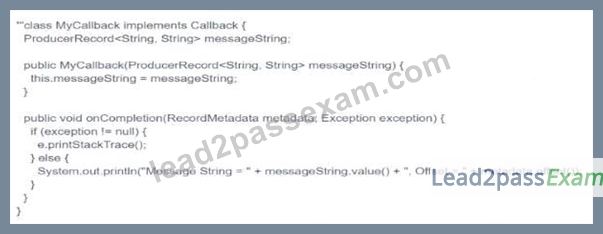
producer.send(record, new MyCallback(record));
- A. Its position in the producer's batch of messages
- B. The number of bytes that overflowed beyond a producer batch of messages
- C. The sequential id of the message is committed into a partition
- D. The id of the partition that the message was committed to
Answer: C
NEW QUESTION # 40
Your Kafka cluster has five brokers. The topic t1 on the cluster has:
* Two partitions
* Replication factor = 4
* min.insync.replicas = 3You need strong durability guarantees for messages written to topic t1.You configure a producer acks=all and all the replicas for t1 are in-sync.How many brokers need to acknowledge a message before it is considered committed?
- A. 0
- B. 1
- C. 2
- D. 3
Answer: B
Explanation:
With acks=all, the leader waits formin.insync.replicasto acknowledge the message. Since min.insync.
replicas=3, Kafka will only commit the messageonce 3 brokers (leader + 2 followers)confirm they have the message.
FromKafka Documentation > Acks and Durability:
"If acks=all is specified, the producer will wait until the full set of in-sync replicas has acknowledged the record. The minimum number of in-sync replicas is controlled by min.insync.replicas." Even though the replication factor is 4, only3 acknowledgments are needed, as defined by min.insync.
replicas.
Reference:Apache Kafka Producer Configs > acks, min.insync.replicas
NEW QUESTION # 41
You need to set alerts on key broker metrics to trigger notifications when the cluster is unhealthy.
Which are three minimum broker metrics to monitor?
(Select three.)
- A. kafka.controller:type=KafkaController,name=OfflinePartitionsCount
- B. kafka.controller:type=ControllerStats,name=UncleanLeaderElectionsPerSec
- C. kafka.controller:type=KafkaController,name=TopicsToDeleteCount
- D. kafka.controller:type=KafkaController,name=LastCommittedRecordOffset
- E. kafka.controller:type=KafkaController,name=ActiveControllerCount
Answer: A,B,E
Explanation:
These three metrics are critical for cluster health:
* OfflinePartitionsCount: Indicates partitions without active leaders - a sign of broker failure.
* ActiveControllerCount: There should beexactly one active controller. A count # 1 signals controller failure.
* UncleanLeaderElectionsPerSec: Tracks leader elections where out-of-sync replicas were selected - risky for data loss.
FromKafka Monitoring Documentation:
"Offline partitions and unclean leader elections should trigger alerts. Also, ensure a single active controller is running."
* A is about topics pending deletion - not critical.
* E is a per-topic record metric, not broker-level.
Reference:Kafka Monitoring > Key JMX Metrics
NEW QUESTION # 42
We want the average of all events in every five-minute window updated every minute. What kind of Kafka Streams window will be required on the stream?
- A. Hopping window
- B. Session window
- C. Sliding window
- D. Tumbling window
Answer: A
Explanation:
A hopping window is defined by two propertiesthe window's size and its advance interval (aka "hop"), e.g., a hopping window with a size 5 minutes and an advance interval of 1 minute.
NEW QUESTION # 43
What is true about partitions? (select two)
- A. A partition has one replica that is a leader, while the other replicas are followers
- B. You cannot have more partitions than the number of brokers in your cluster
- C. A broker can have different partitions numbers for the same topic on its disk
- D. A broker can have a partition and its replica on its disk
- E. Only out of sync replicas are replicas, the remaining partitions that are in sync are also leader
Answer: A,C
Explanation:
Only one of the replicas is elected as partition leader. And a broker can definitely hold many partitions from the same topic on its disk, try creating a topic with 12 partitions on one broker!
NEW QUESTION # 44
How often is log compaction evaluated?
- A. Every time a new partition is created
- B. Every time a message is flushed to disk
- C. Every time a message is sent to Kafka
- D. Every time a segment is closed
Answer: D
Explanation:
Log compaction is evaluated every time a segment is closed. It will be triggered if enough data is "dirty" (see dirty ratio config)
NEW QUESTION # 45
Compaction is enabled for a topic in Kafka by setting log.cleanup.policy=compact. What is true about log compaction?
- A. After cleanup, only one message per key is retained with the first value
- B. After cleanup, only one message per key is retained with the latest value
- C. Each message stored in the topic is compressed
- D. Kafka automatically de-duplicates incoming messages based on key hashes
Answer: B
Explanation:
Compaction changes the offset of messages
Explanation:
Log compaction retains at least the last known value for each record key for a single topic partition. All compacted log offsets remain valid, even if record at offset has been compacted away as a consumer will get the next highest offset.
NEW QUESTION # 46
To transform data from a Kafka topic to another one, I should use
- A. Kafka Connect Sink
- B. Consumer + Producer
- C. Kafka Connect Source
- D. Kafka Streams
Answer: D
Explanation:
Kafka Streams is a library for building streaming applications, specifically applications that transform input Kafka topics into output Kafka topics
NEW QUESTION # 47
You have a Kafka cluster and all the topics have a replication factor of 3. One intern at your company stopped a broker, and accidentally deleted all the data of that broker on the disk. What will happen if the broker is restarted?
- A. The broker will crash
- B. The broker will start, and won't have any data. If the broker comes leader, we have a data loss
- C. The broker will start, and won't be online until all the data it needs to have is replicated from other leaders
- D. The broker will start, and other topics will also be deleted as the broker data on the disk got deleted
Answer: C
Explanation:
Kafka replication mechanism makes it resilient to the scenarios where the broker lose data on disk, but can recover from replicating from other brokers. This makes Kafka amazing!
NEW QUESTION # 48
To allow consumers in a group to resume at the previously committed offset, I need to set the proper value for...
- A. value.deserializer
- B. auto.offset.resets
- C. group.id
- D. enable.auto.commit
Answer: C
Explanation:
Setting a group.id that's consistent across restarts will allow your consumers part of the same group to resume reading from where offsets were last committed for that group
NEW QUESTION # 49
Which topic stores the sink connector offsets?
- A. Topic name from config.storage.topic
- B. Topic name from offset.storage.topic
- C. _consumer_offset
- D. Topic name from status.storage.topic
Answer: B
NEW QUESTION # 50
To continuously export data from Kafka into a target database, I should use
- A. Kafka Connect Sink
- B. Kafka Producer
- C. Kafka Streams
- D. Kafka Connect Source
Answer: A
Explanation:
Kafka Connect Sink is used to export data from Kafka to external databases and Kafka Connect Source is used to import from external databases into Kafka.
NEW QUESTION # 51
......
Get Ready to Pass the CCDAK exam with Confluent Latest Practice Exam : https://theexamcerts.lead2passexam.com/Confluent/valid-CCDAK-exam-dumps.html