

VALID CAPM Exam Dumps For Certification Exam Preparation
CAPM Dumps PDF 2026 Strategy Your Preparation Efficiently
The Project Management Institute's Certified Associate in Project Management (CAPM) certification is a valuable credential for individuals looking to start a career in project management or enhance their current skills. The CAPM exam is designed to measure a candidate's knowledge and understanding of project management principles and terminology. Preparing for the exam can be challenging, but the Project Management Institute offers a variety of resources to help candidates succeed. Earning the CAPM certification can lead to new career opportunities, higher salaries, and increased job satisfaction.
The PMI Certified Associate in Project Management (CAPM) certification demonstrates that a successful candidate possesses an in-depth understanding of the principles and terminology outlined in ‘A Guide to the Project Management Body of Knowledge’, which describes commonly recognized good practices in project management. To earn this certificate, the applicants need to meet some educational requirements and pass the corresponding exam.
To be eligible for the PMI CAPM certification exam, candidates must have a secondary degree, such as a high school diploma or an associate degree, and 1,500 hours of project experience or 23 hours of project management education.
NEW QUESTION # 349
Which process is engaged when a project team member makes a change to project budget with the project manager's approval?
- A. Determine Budget
- B. Estimate Costs
- C. Manage Cost Plan
- D. Control Costs
Answer: D
NEW QUESTION # 350
A project manager is addressing risks and potential concerns related to stakeholder management, and is clarifying and resolving previously identified issues. In which process is the project manager engaged?
- A. Identify Stakeholders
- B. Manage Stakeholder Engagement
- C. Monitor Stakeholder Engagement
- D. Plan Stakeholder Engagement
Answer: B
NEW QUESTION # 351
Projects are separated into phases or subprojects; these phases include:
- A. feasibility study, concept development, design, and prototype.
- B. Identify Stakeholders, develop concept, build, and test.
- C. Develop Charter, Define Activities, Manage Stakeholder Expectations, and Report Performance.
- D. initiate, plan, execute, and monitor.
Answer: A
Explanation:
Section: Volume E
NEW QUESTION # 352
Stakeholder identification and engagement should begin during what phrase of the project?
- A. After the communications management plan is completed
- B. After the project management is completed
- C. After the stakeholder engagement plan is completed
- D. As soon as the project charter has been approved
Answer: D
Explanation:
Section: Volume E
Explanation/Reference: https://pmstudycircle.com/2012/06/identify-stakeholders-project-management/
NEW QUESTION # 353
Which type of probability distribution is used to represent uncertain events such as the outcome of a test or a possible scenario in a decision tree?
- A. Linear
- B. Continuous
- C. Uniform
- D. Discrete
Answer: D
Explanation:
Explanation/Reference:
Explanation:
Decision Tree Analysis. A diagramming and calculation technique for evaluating the implications of a chain of multiple options in the presence of uncertainty.
- Can only be used with discrete data.
NEW QUESTION # 354
Stakeholders can be identified in later stages of the project because the Identify Stakeholders process should be:
- A. Discrete
- B. Arbitrary
- C. Continuous
- D. Regulated
Answer: C
Explanation:
Explanation/Reference:
Explanation:
Process: 13.1 Identify Stakeholders
Definition: The process of identifying the people, groups, or organizations that could impact or be impacted by a decision, activity, or outcome of the project; and analyzing and documenting relevant information regarding their interests, involvement, interdependencies, influence, and potential impact on project success.
Key Benefit: The key benefit of this process is that it allows the project manager to identify the appropriate focus for each stakeholder or group of stakeholders.
Inputs
1. Project charter
2. Procurement documents
3. Enterprise environmental factors
4. Organizational process assets
Tools & Techniques
1. Stakeholder analysis
2. Expert judgment
3. Meetings
Outputs
1. Stakeholder register
NEW QUESTION # 355
Which input to the Manage Stakeholder Engagement process is used to document changes that occur during the project?
- A. Issue log
- B. Change log
- C. Change requests
- D. Expert judgment
Answer: B
Explanation:
Explanation/Reference:
Explanation:
4.5.3.2 Change Log
A change log is used to document changes that occur during a project. These changes and their impact to the project in terms of time, cost, and risk, are communicated to the appropriate stakeholders.
Rejected change requests are also captured in the change log.
13.3 Manage Stakeholder Engagement
Definition: The process of communicating and working with stakeholders to meet their needs/ expectations, address issues as they occur, and foster appropriate stakeholder engagement in project activities throughout the project life cycle.
Key Benefit: The key benefit of this process is that it allows the project manager to increase support and minimize resistance from stakeholders, significantly increasing the chances to achieve project success.
Inputs
1. Stakeholder management plan
2. Communications management plan
3. Change log
4. Organizational process assets
Tools & Techniques
1. Communication methods
2. Interpersonal skills
3. Management skills
Outputs
1. Issue log
2. Change requests
3. Project management plan updates
4. Project documents updates
5. Organizational process assets updates
NEW QUESTION # 356
The process improvement plan details the steps for analyzing processes to identify activities which enhance their:
- A. status.
- B. quality.
- C. technical performance.
- D. value.
Answer: D
Explanation:
Explanation/Reference:
Explanation:
8.1.3.2 Process Improvement Plan
The process improvement plan is a subsidiary or component of the project management plan (Section
4.2.3.1).
The process improvement plan details the steps for analyzing project management and product development processes to identify activities that enhance their value.
Areas to consider include:
Process boundaries. Describe the purpose of the process, the start and end of the process, its inputs
and outputs, the process owner, and the stakeholders of the process.
Process configuration. Provides a graphic depiction of processes, with interfaces identified, used to
facilitate analysis.
Process metrics. Along with control limits, allows analysis of process efficiency.
Targets for improved performance. Guide the process improvement activities.
NEW QUESTION # 357
Which stakeholder approves a project's result?
- A. Sponsor
- B. Functional manager
- C. Customer
- D. Seller
Answer: C
Explanation:
Section: Volume B
NEW QUESTION # 358
A project manager seeking insight on previous stakeholder management plans and their effectiveness should evaluate:
- A. Historical information and the stakeholder register.
- B. Project documents and historical information.
- C. Historical information and the lessons-learned database.
- D. Organizational process assets and the lessons-learned database.
Answer: C
Explanation:
Section: Volume C
Explanation:
13.2.1.4 Organizational Process Assets
Described in Section 2.1.4. All organizational process assets are used as inputs for the Plan Stakeholder Management process. Of these, lessons learned database and historical information are of particular importance, because they provide insights on previous stakeholder management plans and their effectiveness. These can be used to plan the stakeholder management activities for the current project.
13.2.3.1 Stakeholder Management Plan
The stakeholder management plan is a component of the project management plan (Section 4.2.3.1) and identifies the management strategies required to effectively engage stakeholders. The stakeholder management plan can be formal or informal, highly detailed or broadly framed, based on the needs of the project.
In addition to the data gathered in the stakeholder register, the stakeholder management plan often provides:
Desired and current engagement levels of key stakeholders;
Scope and impact of change to stakeholders;
identified interrelationships and potential overlap between stakeholders;
Stakeholder communication requirements for the current project phase;
Information to be distributed to stakeholders, including language, format, content, and level of detail;
Reason for the distribution of that information and the expected impact to stakeholder engagement;
Time frame and frequency for the distribution of required information to stakeholders; and
Method for updating and refining the stakeholder management plan as the project progresses and develops.
Project managers should be aware of the sensitive nature of the stakeholder management plan and take appropriate precautions. For example, information on stakeholders who are resistant to the project can be potentially damaging, and due consideration should be given regarding the distribution of such information.
When updating the stakeholder management plan, the validity of underlying assumptions should be reviewed to ensure continued accuracy and relevancy.
NEW QUESTION # 359
The project manager at an organization has just realized that some of the engineering staff has been allocated to project Y and will not be available to finish task X.
The project manager has also discovered that at the current pace, it will not be possible to complete the project on time. Due to cost constraints, hiring more work force is not a viable option. Which tools are at the manager's disposal?
- A. Scheduling tools and applying leads and lags
- B. Crashing and applying leads and lags
- C. Resource leveling and fast tracking
- D. Fast tracking and crashing
Answer: C
Explanation:
Explanation/Reference:
Explanation:
6.6.2.7 Schedule Compression
Schedule compression techniques are used to shorten the schedule duration without reducing the project scope, in order to meet schedule constraints, imposed dates, or other schedule objectives. Schedule compression techniques include, but are not limited to:
Crashing. A technique used to shorten the schedule duration for the least incremental cost by adding
resources. Examples of crashing include approving overtime, bringing in additional resources, or paying to expedite delivery to activities on the critical path. Crashing works only for activities on the critical path where additional resources will shorten the activity's duration. Crashing does not always produce a viable alternative and may result in increased risk and/or cost.
Fast tracking. A schedule compression technique in which activities or phases normally done in
sequence are performed in parallel for at least a portion of their duration. An example is constructing the foundation for a building before completing all of the architectural drawings. Fast tracking may result in rework and increased risk. Fast tracking only works if activities can be overlapped to shorten the project duration.
NEW QUESTION # 360
When would resource leveling be applied to a schedule model?
- A. Before it has been analyzed by the critical path method
- B. After critical activities have been removed from the critical path
- C. After it has been analyzed by the critical path method
- D. Before constraints have been identified
Answer: C
Explanation:
Section: Volume C
Explanation:
6.6.2.2 Critical Path Method
The critical path method, which is a method used to estimate the minimum project duration and determine the amount of scheduling flexibility on the logical network paths within the schedule model. This schedule network analysis technique calculates the early start, early finish, late start, and late finish dates for all activities without regard for any resource limitations by performing a forward and backward pass analysis through the schedule network, as shown in Figure 6-18. In this example the longest path includes activities A, C, and D, and, therefore, the sequence of A-C-D is the critical path. The critical path is the sequence of activities that represents the longest path through a project, which determines the shortest possible project duration. The resulting early and late start and finish dates are not necessarily the project schedule, rather they indicate the time periods within which the activity could be executed, using the parameters entered in the schedule model for activity durations, logical relationships, leads, lags, and other known constraints. The critical path method is used to calculate the amount of scheduling flexibility on the logical network paths within the schedule model.
On any network path, the schedule flexibility is measured by the amount of time that a schedule activity can be delayed or extended from its early start date without delaying the project finish date or violating a schedule constraint, and is termed "total float." A CPM critical path is normally characterized by zero total float on the critical path. As implemented with PDM sequencing, critical paths may have positive, zero, or negative total float depending on constraints applied. Any activity on the critical path is called a critical path activity. Positive total float is caused when the backward pass is calculated from a schedule constraint that is later than the early finish date that has been calculated during forward pass calculation. Negative total float is caused when a constraint on the late dates is violated by duration and logic. Schedule networks may have multiple near-critical paths. Many software packages allow the user to define the parameters used to determine the critical path(s).
Adjustments to activity durations (if more resources or less scope can be arranged), logical relationships (if the relationships were discretionary to begin with), leads and lags, or other schedule constraints may be necessary to produce network paths with a zero or positive total float. Once the total float for a network path has been calculated, then the free float-the amount of time that a schedule activity can be delayed without delaying the early start date of any successor or violating a schedule constraint-can also be determined. For example the free float for Activity B, in Figure 6-18, is 5 days.
NEW QUESTION # 361
A project manager is reviewing some techniques that can be used to evaluate solution results.
The intent is to evaluate the solution in the larger context to ensure it does not behave in unacceptable ways when deployed to production.
Which evaluation technique should be used here?
- A. Day-in-the-life testing
- B. Exploratory testing
- C. Performance testing
- D. Integration testing
Answer: A
NEW QUESTION # 362
The following is a network diagram for a project.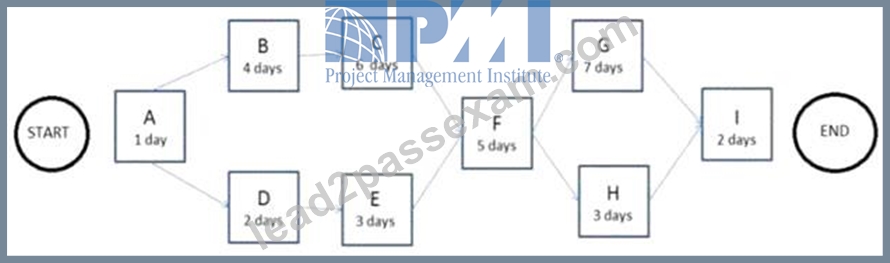
The total float for the project is how many days?
- A. 0
- B. 1
- C. 2
- D. 3
Answer: A
NEW QUESTION # 363
Which Define Activities tool or technique is used for dividing and subdividing the project scope and project deliverables into smaller, more manageable parts?
- A. Document analysis
- B. Decomposition
- C. Inspection
- D. Project analysis
Answer: B
Explanation:
Section: Volume B
Explanation:
5.4.2.1 Decomposition
Decomposition is a technique used for dividing and subdividing the project scope and project deliverables into smaller, more manageable parts. The work package is the work defined at the lowest level of the WBS for which cost and duration can be estimated and managed. The level of decomposition is often guided by the degree of control needed to effectively manage the project. The level of detail for work packages will vary with the size and complexity of the project. Decomposition of the total project work into work packages generally involves the following activities:
Identifying and analyzing the deliverables and related work;
Structuring and organizing the WBS;
Decomposing the upper WBS levels into lower-level detailed components;
Developing and assigning identification codes to the WBS components; and
Verifying that the degree of decomposition of the deliverables is appropriate.
Process: 6.2 Define Activities
Definition: The process of identifying and documenting the specific actions to be performed to produce the project deliverables.
Key Benefit: The key benefit of this process is to break down work packages into activities that provide a basis for estimating, scheduling, executing, monitoring, and controlling the project work.
Inputs
1. Schedule management plan
2. Scope baseline
3. Enterprise environmental factors
4. Organizational process assets
Tools & Techniques
1. Decomposition
2. Rolling wave planning
3. Expert judgment
Outputs
1. Activity list
2. Activity attributes
3. Milestone list
NEW QUESTION # 364
What is an objective of the Develop Project Team process?
- A. Functional managers becoming more involved
- B. Enhanced resource availability
- C. Feelings of trust and improved cohesiveness
- D. Ground rules for interaction
Answer: C
Explanation:
Section: Volume C
Explanation:
Process: 9.3 Develop Project Team
Definition: The process of improving competencies, team member interaction, and overall team environment to enhance project performance.
Key Benefit: The key benefit of this process is that it results in improved teamwork, enhanced people skills and competencies, motivated employees, reduced staff turnover rates, and improved overall project performance.
Inputs
1. Human resource management plan
2. Project staff assignments
3. Resource calendars
Tools & Techniques
1. Interpersonal skills
2. Training
3. Team-building activities
4. Ground rules
5. Colocation
6. Recognition and rewards
7. Personnel assessment tools
Outputs
1. Team performance assessments
2. Enterprise environmental factors updates
NEW QUESTION # 365
A new project has been set. Four main stakeholders besides the project manager and four other team members have been identified.
How many communication channels are available?
- A. 0
- B. 1
- C. 2
- D. 3
Answer: C
NEW QUESTION # 366
Projects can be divided into phases to provide better management control. Collectively, what are these phases known as?
- A. Complete project phase
- B. Project life
- C. Project cycle
- D. The project life cycle
Answer: D
NEW QUESTION # 367
Which defines the portion of work included in a contract for items being purchased or acquired?
- A. Procurement management plan
- B. Work breakdown structure
- C. Procurement statement of work
- D. Evaluation criteria
Answer: C
Explanation:
Section: Volume C
NEW QUESTION # 368
The following is a network diagram for a project.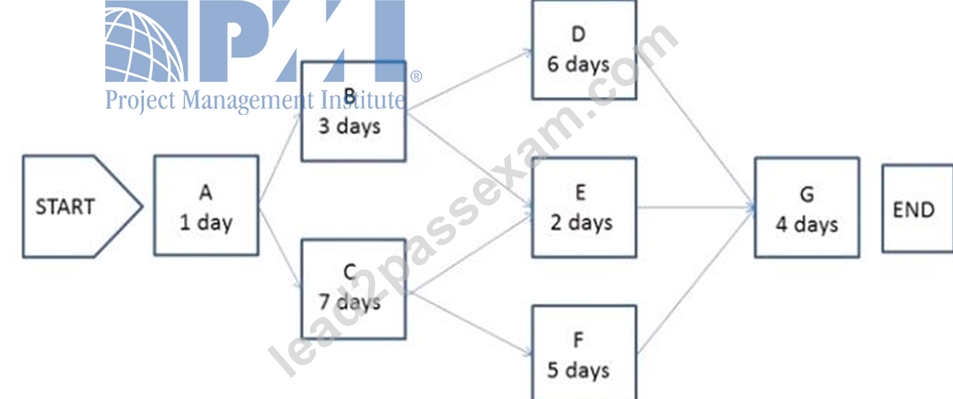
The critical path for the project is how many days in duration?
- A. 0
- B. 1
- C. 2
- D. 3
Answer: A
NEW QUESTION # 369
If a project manager effectively manages project knowledge, a key benefit is that:
- A. all stakeholders have access to the same information
- B. project stakeholders have a clear picture of the project
- C. the project team is able to understand the project status
- D. new knowledge is added to organizational process assets
Answer: B
NEW QUESTION # 370
......
Latest Verified & Correct CAPM Questions: https://theexamcerts.lead2passexam.com/PMI/valid-CAPM-exam-dumps.html